 TEXTILES.ORG




The evolution of the design for geosynthetic reinforced Mechanically Stabilized Earth (MSE) walls was discussed in part I of this article.
The article discussed the development of the “Simplified Method” in the 1990s and replacing Allowable Stress Design (ASD) with the Load and Resistance Factor Design (LRFD) platform starting in 2007.
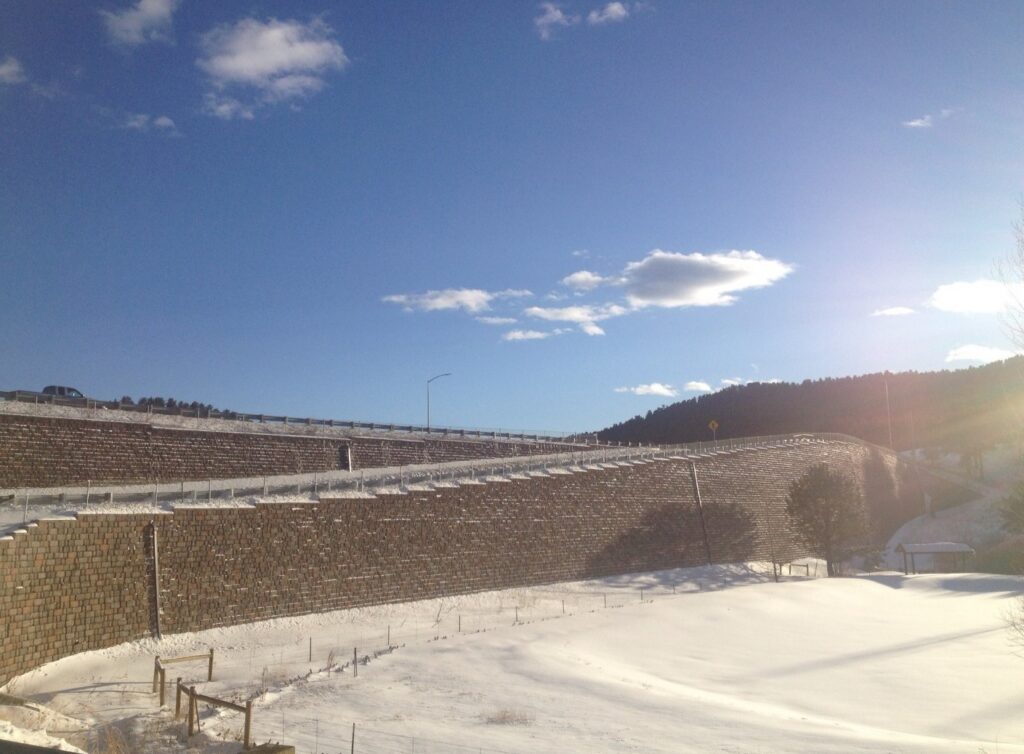
In 2020, AASHTO replaced the simplified method with two new methods for designing MSE walls with extensible reinforcement. The Stiffness Method and the Limit Equilibrium (LE) methods were introduced in the AASHTO Bridge Design Specifications, 9th edition. The FHWA also revised the Geotechnical Engineering Circular (GEC) number 11 (FHWA-HIF-24-002) which added details on the use of these design methods including design examples.
These changes to AASHTO section 11.10 on the design of MSE walls have had mixed reception and utilization. Although AASHTO and FHWA provided good guidance in the design implementation method neither included reasoning in selecting which method to use for design. Part II of this article discusses the considerations and impact related to design, construction, and performance of the selected design method.
Stiffness Method (Allen and Bathurst):
- Design
- The primary difference from the simplified method is that it accounts for the stiffness of the components of the selected system including reinforcement, facing, connection and wall batter.
- In addition, this method considerers a soil failure limit for internal stability. This design check restrains the overall design from developing a failure plane by controlling the maximum strain along the failure surface.
- The design process and required information is more detailed than for the simplified method.
- The ability of this method to include the contribution of the facing can result in a design section which requires less overall reinforcement.
- Construction
- The design can result in similar or reduced overall demand for reinforcement. The difference is that the distribution of reinforcement is generally more uniform. This has the effect of reducing number of reinforcement types in addition to maintaining a more uniform vertical spacing from bottom to top of the wall.
- This method has the potential to improve efficiency, constructability, and minimize construction errors. The design can optimize the vertical spacing for one reinforcement type for a given spacing. Minimizing the vertical steps of the reinforcement typically needed as wall heights change.
- Performance
- Wall should continue to perform the same as with the simplified method while utilizing a more efficient reinforcement layout.
Limit Equilibrium Method (Leshchinsky, D):
- Design
- The design models the equilibrium of potential failure surfaces through the reinforced soil mass utilizing classical Limit Equilibrium (LE) methods such as Bishop, Spencer, or others. This analysis utilizes commercially available slope stability software.
- Compound and global stability can also be evaluated with the same model.
- This model allows the designer to more accurately model overall geometry, variability in geotechnical profiles and ground water without the simplifying assumptions made by lateral earth pressure models like Rankin and Coulomb.
- LEM allows the designer to model variable reinforcement length which can be an advantage in more complex sites.
- The contribution of secondary reinforcement can be included within the analysis which can result in reduced demand on the primary reinforcement layers. Other models don’t have a mechanism to incorporate the contribution of the secondary reinforcement layers.
- There is a need for more advanced experience and understanding of the behavior of MSE walls and running LE stability software.
- Construction
- The use of secondary (4 – 6 foot long) reinforcements in between the primary reinforcement elements can improve the overall constructability of the wall. Secondary reinforcement improves confinement of the fill along the face of the wall which can minimize alignment issues that sometimes occur during fill placement and compaction.
- Because the LEM method allows the accounting of the contribution from secondary reinforcement it can have the effect of reducing the requirements for the primary layers, reducing costs while improving performance. These benefits could encourage more widespread use in design which would improve performance.
- Performance
- LEM has the effect of encouraging better design and construction practice by reducing the spacing of the reinforcement at the face which improves wall alignment and long-term performance.
- LEM results in a more uniform distribution of loads minimizing the number of reinforcement types on site and encouraging more uniform vertical spacing improving constructability and reducing errors.
- In some cases, resulting in lower overall demand for reinforcement which reduces costs.
In summary, the Simplified, Stiffness, and LE methods are currently the three design methods that are available in AASHTO for the design of MSE walls with extensible (geosynthetic) reinforcement. All three methods deliver a design that is safe, constructible, and economical. The simplified method is widely used and accepted but can be more conservative than a design utilizing the other methods. Currently the simplified method is utilized for design and as with all innovations it will take some time and experience for engineers and owners to develop confidence in new procedures.
Daniel E. Alzamora, P.E., is a contributing editor for Geosynthetics and has spent more than three decades in the geosynthetics industry in both the public and private sectors.
For additional information:
- Evolution of MSE wall design with geosynthetic reinforcement – Part I, Geosynthetic Magazine, July 27, 2026
- LRFD Bridge Design Specifications, 9th & 10th Editions, Washington, DC: American Association of State Highway and Transportation Officials.
- Design and Construction of Mechanically Stabilized Earth Walls. Publication No. FHWA-HIF-24-002. https://www.fhwa.dot.gov/engineering/geotech/pubs/hif24002.pdf
- “Improved Simplified Method for Prediction of Loads in Reinforced Soil Walls.” ASCE Journal of Geotechnical and Geoenvironmental Engineering, 141(11), 04015049.
- “Application of the Stiffness Method to Design of Complementary Geosynthetic Reinforced Soil Walls.” ASCE Journal of Geotechnical and Geoenvironmental Engineering, 144(5), 04018024.
- Limit Equilibrium Design Framework for MSE Structures with Extensible Reinforcement, Report No. FHWA-HIF-17-004. https://www.fhwa.dot.gov/engineering/geotech/pubs/hif17004.pdf
- “Geosynthetic reinforced soil 101 leading to rational design of MSE walls and slopes: Parts 1 & 2.” Geosynthetics Magazine, April/June Issues, Leshchinsky, D. (2017).