 TEXTILES.ORG




Mechanically Stabilized Earth (MSE) walls have evolved considerably over the past 35 years in relation to facing options, reinforcement types, material testing and design methodologies.
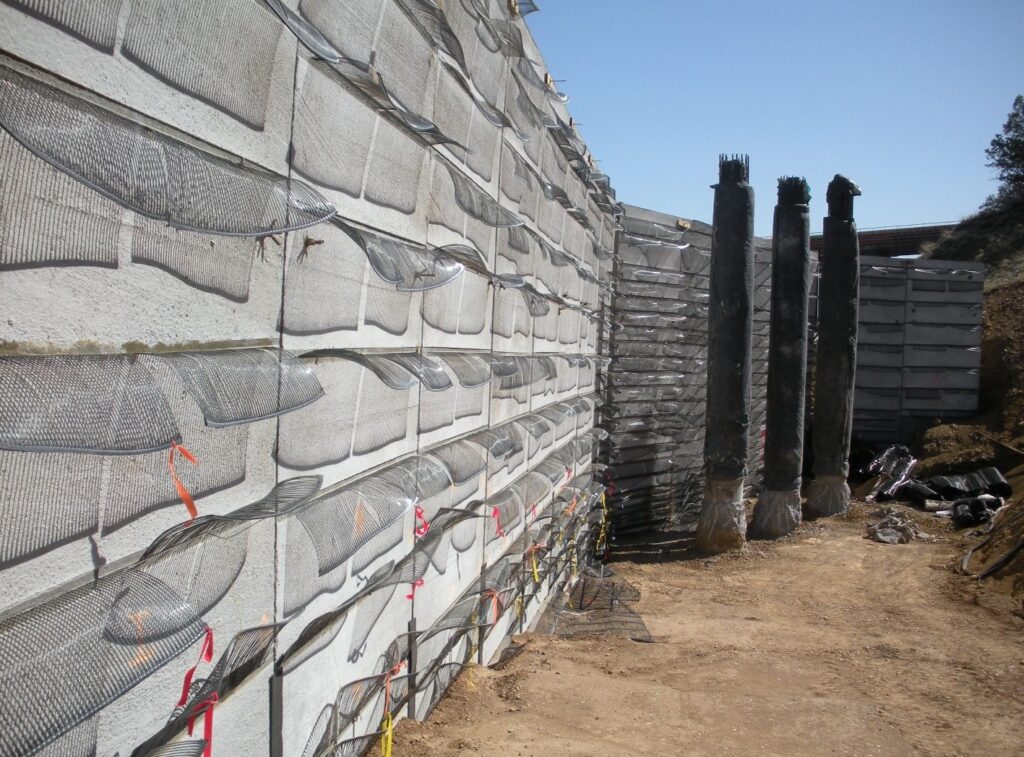
This two-part article will focus on the evolution of design methods over the past 35 years specifically related to the utilization of geosynthetics which are generally considered as extensible reinforcements for the purpose of selecting a design approach. Starting in the 1990’s the “Simplified Method” was developed by an American Association of State Highway Officials (AASHTO) technical working group to resolve the complexity of managing the different methods available at the time. The Simplified Method normalized the design approach into a single framework which allowed the use of different types of reinforcements. This method continues to be the prominent method being used in design of MSE walls utilizing extensible reinforcements.
Extensibility is a comparison of the strain characteristics of the reinforcement material as compared to the soil being reinforced. In simple terms, reinforcement that can strain the same or more than the soil at failure is considered extensible. On the other hand, reinforcements that fail at strain levels much less than soil are considered inextensible, for example steel. This definition allows the design to account for strain compatibility of the reinforcement versus the soil. The result is inextensible reinforcements generally see higher loads since the soil is not allowed to strain therefore more of the load is taken by the reinforcement. Extensible reinforcements allow for the soil to take some of the load through a small amount of deformation therefore sharing the total lateral load between the soil and reinforcement resulting in lower loads. This is an important concept in this discussion since geosynthetics are considered extensible reinforcements and follow those procedures. Currently there are three design methods in AASHTO which can be used for extensible reinforcements.
Around the mid-2000 AASHTO transitioned from an allowable stress design (ASD) approach to a Load and Resistance Factor Design (LRFD). The main difference between the two platforms was how each managed uncertainty of the loads and resistances.
The ASD approach combined all the uncertainty in a single factor of safety (FS) for each failure mode. The design would require a minimum factor of safety for each design criteria. The LRFD method considered the uncertainty of each source of load and assigned a load factor as well as considering the uncertainty from the corresponding resistance by applying a resistance factor. The design would then compare the sum of the factored loads for a given design case as compared to the factored resistance for a given mode of failure. The factored resistance needed to be greater than the sum of the factored loads. Initially the resistance factors for the LRFD platform were back calibrated to match the results of an ASD design. The objective was to eventually calibrate the load factors and resistance factors through load testing and research to improve the design model. To date this has not been done and the back calibrated LRFD factors are still being utilized.
In the mid 2010s there was discussion by AASHTO of the conservative nature of the design when utilizing the Simplified Method for extensible reinforcements. This discussion led to the introduction of the Stiffness Method (Allen and Bathurst) and the Limit Equilibrium Method (Leshchinsky, D) in the AASHTO LRFD Bridge Design Specifications, 9th Edition, 2020. In this publication the stiffness method was set as the default when utilizing extensible reinforcement although the LEM and simplified were allowed. This publication also set the standard for inextensible reinforcement to be the coherent gravity method although the simplified method could also be used.
Having gone full circle back to having multiple methods available for design, how does a designer select a method when multiple methods are allowed? Part II of this article will discuss the impact on design, construction and performance as related to the selected design method.
Daniel E. Alzamora, P.E., is a contributing editor for Geosynthetics and has spent more than three decades in the geosynthetics industry in both the public and private sectors.
Read more in part II of this article.
For additional information:
- LRFD Bridge Design Specifications, 9th & 10th Editions. Washington, DC: American Association of State Highway and Transportation Officials.
- Design and Construction of Mechanically Stabilized Earth Walls. Publication No. FHWA-HIF-24-002. https://www.fhwa.dot.gov/engineering/geotech/pubs/hif24002.pdf
- “Improved Simplified Method for Prediction of Loads in Reinforced Soil Walls.” ASCE Journal of Geotechnical and Geoenvironmental Engineering, 141(11), 04015049. https://ascelibrary.com/doi/abs/10.1061/%28ASCE%29GT.1943-5606.0001874
- “Application of the Stiffness Method to Design of Complementary Geosynthetic Reinforced Soil Walls.” ASCE Journal of Geotechnical and Geoenvironmental Engineering, 144(5), 04018024. https://ascelibrary.org/doi/10.1061/%28ASCE%29GT.1943-5606.0001874
- Limit Equilibrium Design Framework for MSE Structures with Extensible Reinforcement, Report No. FHWA-HIF-17-004. https://www.fhwa.dot.gov/engineering/geotech/pubs/hif17004.pdf
- “Geosynthetic reinforced soil 101 leading to rational design of MSE walls and slopes: Parts 1 & 2.” Geosynthetics Magazine, April/June Issues, Leshchinsky, D. (April 2017). https://geosyntheticsmagazine.com/2017/04/01/part-1-geosynthetic-reinforced-soil-101-leading-to-rational-design-of-mse-walls-and-slopes/