 TEXTILES.ORG





One year after tariff changeability reshaped North American trade, Canadian textile and findings manufacturers are still navigating U.S. steel and aluminum tariffs, oil price spikes and the United States-Mexico-Canada Agreement (USMCA). Conducting business amid these factors requires leaders to be patient, flexible and willing to take proactive measures.
“The premium that was put on trade with the U.S., Canada’s largest trading partner, delayed a lot of investment decisions,” says Ryan Mallough, vice president of legislative affairs and communications at the Canadian Federation of Independent Business (CFIB). “Many businesses saw a direct hit to the books.”
Canadian textile companies are riding out this period by diversifying revenue streams, reinforcing market positioning and reworking supply chains — while still maintaining critical ties with U.S. partners.
Tracking tariffs
Mallough says his organization saw several businesses pivot and find new supply chains this year, but he adds, “it takes time.” CFIB, which represents small and medium-sized enterprises, urges its members to avoid reacting too quickly to policy signals.
“We’re trying hard to make sure we are up to date and providing the information we can about tariffs,” says Mallough. “Things change quickly. The U.S. president’s Twitter [X] feed gets a ton of eyeballs. We tell our members, ‘Just wait a little bit. The president doesn’t have the power to tweet and make laws. There are a couple of things that need to happen first.’”
Jim Ennis, president and CEO of Ennis Fabrics, based in Sherwood Park, Alta., Canada, agrees that the previous year was unpredictable. “We’ve tracked product-level tariff information in our ERP [enterprise resource planning] system since 2019,” he says. “But it’s still confusing because you don’t know what’s coming.”
ATA Member Benefit Spotlight: ATA Canada
Network with other Canadian textile businesses through membership in the ATA Canada member group.
The international wholesale distributor and supplier of textiles and related supplies for industrial, marine and home decor markets raised prices on U.S.-sourced products while absorbing higher supplier, freight and energy costs last year. “Nobody’s immune to it, except U.S.-made products,” says Ennis. “It was a tough year for our customers and the end consumer.”
Despite these pressures, Ennis Fabrics grew market share in 2025, driven in part by deep inventory and competitive pricing. “When you think it can’t get any crazier, it does. Our motto is: ‘Have patience and watch things play out,’” says Ennis.
Product plans go forward
A strategy Ennis’ company adopted during the COVID-19 pandemic — holding deeper inventory — continues to pay off, allowing the company to meet demand without relying heavily on inconsistent supply chains.
Products such as the company’s Guardian Collection of marine, residential and commercial upholstery vinyl fabrics continue to perform well, particularly in the hospitality and healthcare sectors. “Customers want performance without sacrificing comfort,” says Ennis. “That’s a big area of growth for us.”
In addition to selling fabric for the residential, contract, hospitality and specialty markets, the company has an extensive catalog of supplies for fabricating furniture, desk/office seating, boat tops and awnings. “We’ve been fortunate that in difficult times, one market or another is either up or down, but we service them all,” says Ennis.
EU expansion

“Diversifying our markets has always been good business practice; the tariff war simply brought the deadline forward,” says Marc-Antoine Lachance, president of Adfast Grommeting in Montreal, Que., Canada.
Adfast manufactures brass and stainless-steel grommets, washers and specialized automated Eagle grommet-setting machines. The grommets’ compact shipping size proved advantageous when costs rose. In the future, the company plans to grow its business in Canada and Europe.
“We were pretty lucky that the USMCA agreement still stands. For us, business didn’t change much; we mostly experienced minor shipping delays,” says Lachance. “The European market is a logical next step for growth.”
According to Mallough, many Canadian companies are expanding into or exploring selling in the European Union (EU). Canada benefits from a free-trade agreement with the EU, but companies must consider high transportation costs and sometimes lengthy regulatory timelines, he says.
Lachance says that while grommets pose few regulatory challenges, grommeting machines require compliance with the economic region’s health, safety and environmental regulations — a process that adds time and complexity. In Adfast’s case, this means it sends its grommeting machines to a specialized company that ensures each machine’s safety and electrical issues comply with the mandatory certification. Still, he is eager to get to market in the EU.
“I’m very excited to go with the machine to Europe. But for now, it’s more waiting,” he says.
Reducing domestic sales barriers
CFIB’s Mallough says 2025’s trade battle was a “wake-up call” in terms of not being too over-reliant on a single customer. “I think that easing the trade barriers between provinces will certainly help,” he says.
The Canadian Mutual Recognition Agreement (CMRA), which took effect June 30, aims to reduce the regulatory compliance burden between provinces by allowing products that are lawfully sold in one province or territory to be sold country-wide without needing to meet additional requirements unless a specific rule still applies. The benefits are lower compliance costs for companies doing business across territories, for example in needing fewer product certification tests and less regulatory paperwork. Those small and medium-sized businesses that lack the resources to navigate multiple regulatory systems will benefit from simplified access to a domestic market.
This regulation comes at a time when the country’s small business numbers are contracting, Mallough says. Canada is “in an entrepreneurial drought,” he says, with more businesses leaving the space than are being created. It’s not tied to the U.S. trade challenges alone but is part of this post-pandemic era, where small-business policy wasn’t at the forefront in government and inflation has hit them hard, he explains.
Lachance says Adfast has always had a strong presence in Canada but not to the extent they’d like. “Since the grommet market is highly fragmented, combined with Canada’s sparsely populated geography, traditional sales representation isn’t very cost-effective, which is why our efforts in this area
are primarily online,” he says.
As companies explore interprovincial trade, geography is the main barrier. In many cases, the U.S. is closer. The majority of the Canadian population lives within 99 miles of the U.S. border.
Business goes on
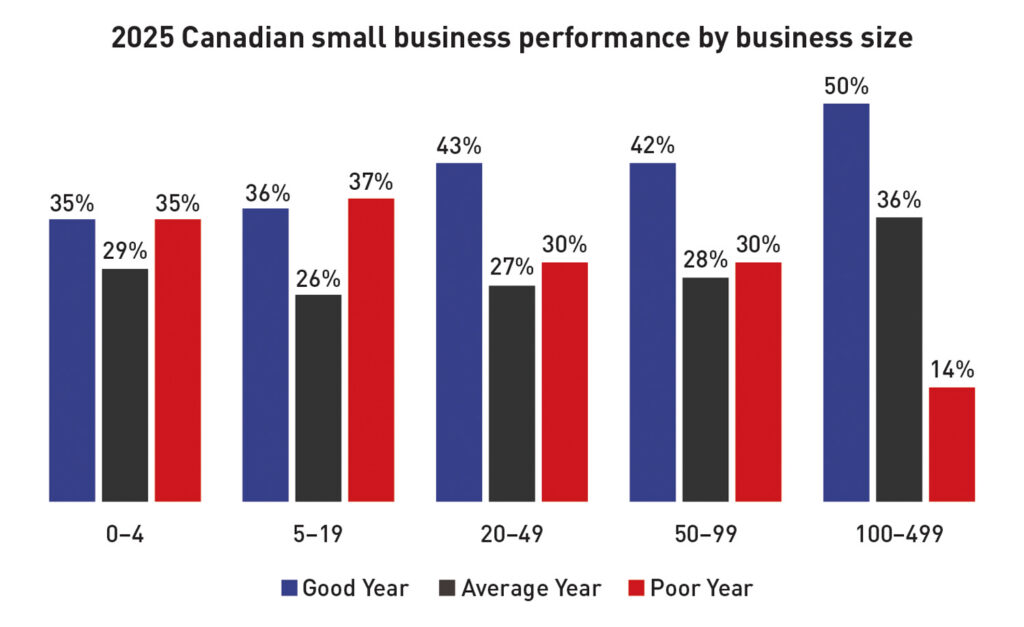
Both Ennis and Lachance say consistency in messaging was critical last year.
“We didn’t change our messaging,” says Ennis. “We have a set brand, we have a vision, values. The most important decision we made was to stay true to our brand promise to our customers.”
Lachance takes a pragmatic approach to the situation, grounded in years of trustworthy product performance and partnerships. “I think with Americans, it’s not what we see in the media,” he says. “U.S. partners remain open to Canadian products. You have to keep moving forward.”
A year on, the industry has not moved away from the U.S., but it has become more disciplined about not depending on it. “Near the end of 2025, we started to see a lot of businesses get a bit more comfortable with uncertainty,” says Mallough. “It was less of a day-to-day or week-to-week change and more of an understanding that the ground can shift, but in the meantime, we still need to conduct business.”
Sara Scullin is a freelance writer and editor based in Wisconsin.
See Specialty Fabrics Review‘s Markets section in every issue for insights on what’s happening in textile markets affecting industry businesses.
How’s 2026 going for you? Discuss this topic further on ATA’s CONNECT forum.