 TEXTILES.ORG





As experienced workers retire faster than new employees can replace them, companies are investing in artificial intelligence and automation tools. Business uses include saving their employees for higher-skilled tasks, improving safety, and developing digital training tools that will help preserve and transfer that generational knowledge quickly.
Companies of all sizes can benefit from cohesive, data-driven systems and teams. However, those teams must also understand the machines, fabrics and workflow. Manufacturers in the process of modernizing and tech-savvy next-gen workers need each other.

Transformative technology at work
Textile manufacturing facilities stand to benefit from technology, including automation, robotics, augmented reality and AI. Facilities cannot implement new technology overnight, nor should they. Instead, it’s about considering legacy systems, collecting data, and then making incremental, informed changes within the company.
“Our textile industry is seeing a truly transformative era, as robotics and advanced automation are redefining what traditional manufacturing looks like,” says Frank Henderson, CEO of Henderson Sewing Machine Co. Inc., Andalusia, Ala.
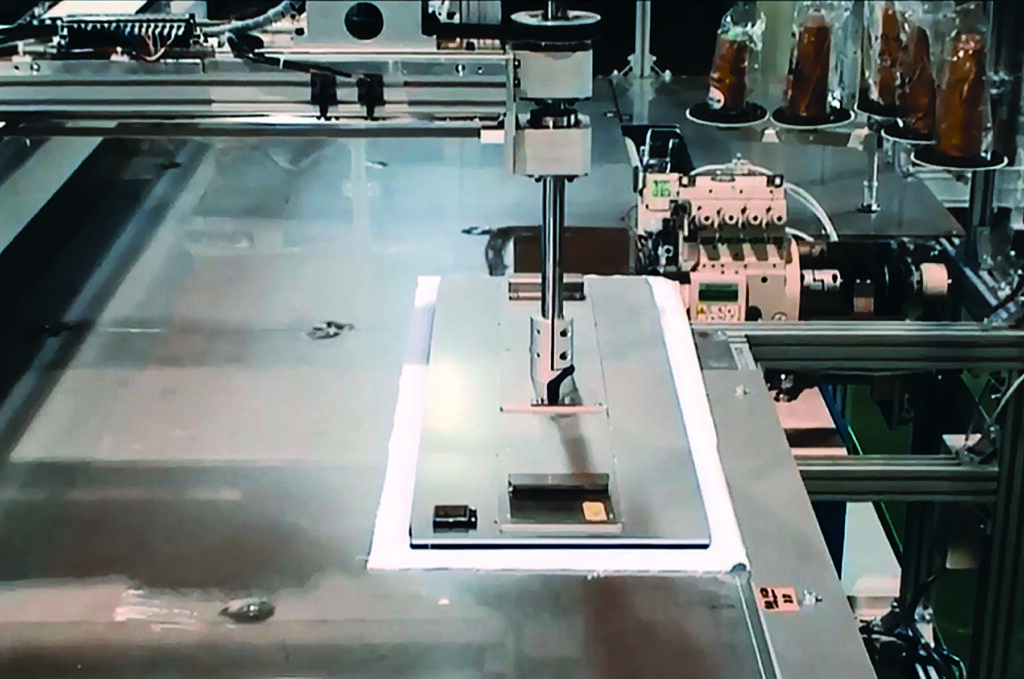
Henderson says a primary goal of incorporating technology is to produce textile-sewn products with as little human labor as is necessary. Yet he emphasizes that automation does not eliminate the need for skilled employees. Rather, it shifts workers toward higher-value tasks requiring deeper technical expertise. He explains that robotics and advanced automation can now perform a large share of traditional textile manufacturing work, especially in operations involving parts and subassemblies.
“We are not affecting the sewing [with automation],” he adds. “We are affecting the material handling. A sewing operator must adapt quickly between operations, sizes and fabrics. A robotic arm simply moves back and forth.”
Henderson says that in the textile industry, automation is most effective when applied to two-dimensional, flat material handling steps such as pockets, collars, cuffs, bands, sheets, pillowcases and other flat components.
“We want to enable the manufacturing of textile products with fewer people performing repetitive tasks. The people we need are more advanced; they understand fabrics, sewing and the sewing machine. They also understand automation,” says Henderson.

Smart sensors and cameras also support positioning, inspection and quality control, including stitch consistency and placement verification. Robotics in a plant can help move heavy rolls, transport materials or load equipment, saving risks to employees from heavy lifting.
Artificial intelligence tools that are not ChatGPT
“For a long time, I feel like [AI’s] often pushed off to the technology department or training and development,” says Jeanne McClure, Ph.D., founder and chief AI architect at Ars Innovate Technologies & Consulting and an NSF Postdoctoral Fellow at North Carolina State University’s Data Science and AI Academy. “A company might hire some data scientists to help pull the data, but in textiles, the data scientists aren’t experts in understanding tension and flow and all those things. I think that we’ve been siloed. But now with AI, we really need to be talking to each other.”
Marcio Manique is the executive vice president and managing director of apparel at Milliken & Co., headquartered in Spartanburg, S.C. Manique says his company uses AI and automation in many ways, including in visual inspections and to shorten lead times for product development.

“It’s really about giving our inventors, engineers and scientists answers quickly so that they have the tools to be more efficient, faster and more creative,” Manique says.

The company uses AI to help improve flow and operational efficiency across its manufacturing footprint, an objective that aligns with larger sustainability goals. AI-powered vision inspection identifies defects more reliably and quickly than human eyes do. AI also is a useful tool for transportation and logistics at the company, helping to optimize material movement across more than 20 manufacturing sites in three states.
“This helps the environment, it helps productivity and it helps humans make better decisions,” Manique says. “The most important asset we have is our associates. We can use AI to empower them.”
The technology also supports the company’s safety efforts and ongoing focus on risk reduction. “AI helps us analyze the data surrounding the environment, including the machine, to help us prevent accidents. This is another great use of AI tools: making us safer. That, as a leader, is my number one job,” says Manique.
Training an AI program to recognize safety standards can include noticing when personnel get too close to moving equipment or are not wearing the required protective equipment, such as high-visibility vests. If there’s a spike in missing vests, management could find, for example, that outside delivery drivers are overlooking the protocols rather than full-time staff and then can address the issue.
Transferring knowledge to next-gen workers
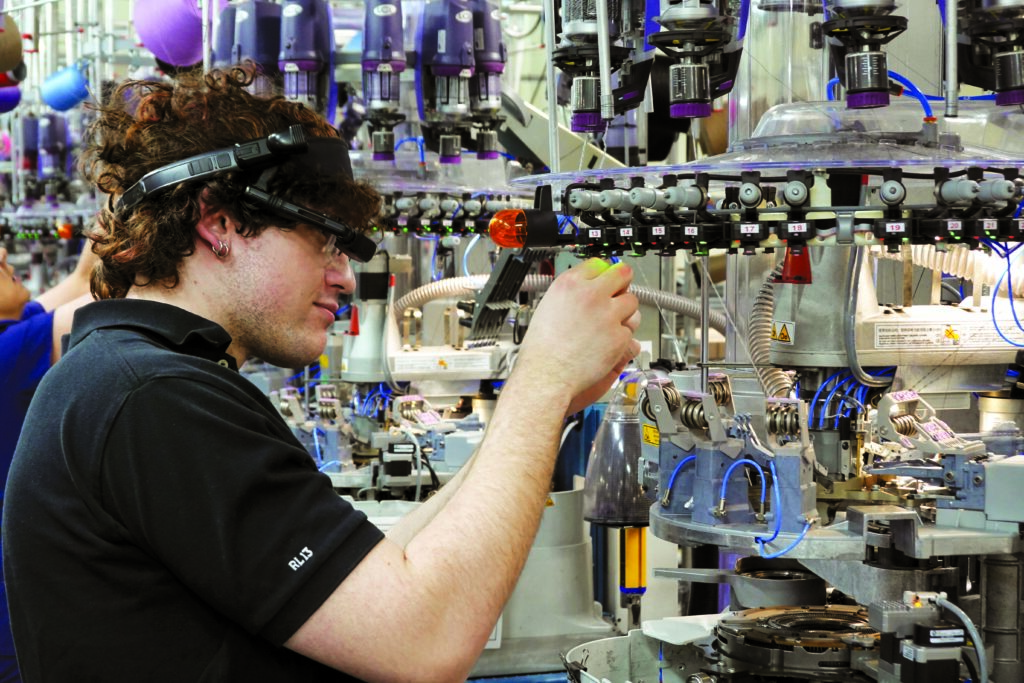
Beyond operational improvements, organizations are developing AI tools for preserving expertise and helping newer employees navigate complex manufacturing environments.
“The biggest single thing that we could do from an AI standpoint, in my opinion, is form a knowledge source: storing the knowledge of the people who are aging or who have already left the industry or left this earth and with them died a large knowledge base,” Henderson says. “This is hugely important to the industry from a training standpoint.”
He says while new technology is helpful and promising, it needs to be used strategically alongside human expertise and ability. This puzzle of integrating new technology with legacy systems and expertise presents a challenge as well as an opportunity. (See sidebar below on augmented reality training tool THREAD-X.)
Yasir Nawab, Ph.D., professor at the National Textile University/University of Kamalia in Pakistan and adjunct professor at North Carolina State University, helps prepare students for careers in modern textile manufacturing.
“Modern textile manufacturing is no longer about machines, materials and production targets,” Nawab says. “It’s increasingly about data, automation, sustainability, traceability, digital design and faster decision-making. Therefore, students must be prepared not only as textile graduates but as problem solvers who can work with technology.”
He argues this preparation should start early, at the university level, with AI literacy, digital confidence and exposure to real industry problems, such as how AI can detect fabric defects or aid in production planning and predictive maintenance. Not all students need to be programmers, he says, but they must understand how to use AI and data intelligently in their field.
“In many cases, students still learn these tools after joining a company,” says Nawab. “That is useful, but it is too late if we want graduates to contribute quickly. Universities should introduce AI and digital tools, while companies should continue this learning through internships, mentorship and workplace training.”
Nawab says textile companies can attract tech-fluent students by highlighting opportunities for purpose, growth and modern work environments. “Companies should offer structured innovation challenges and opportunities to work on real problems,” he says. “They should show students their smart systems, sustainability work, digital tools and global buyer requirements.”
The idea is if students see that textile manufacturing is intertwined with technology, sustainability and innovation, they may find it an attractive career option.

“If you have grads who are understanding both the product and the data side, it will really help companies skip a lot of trial and error,” says McClure. “Real-world data is messy; we have old systems with incomplete records, things that don’t match the documentation. I think that’s where [technology-forward] schools and [manufacturing] can really converge.”
Future textile facilities may be defined less by any single technology than by how effectively manufacturers combine automation, digital tools and human expertise. Companies that successfully transfer institutional knowledge while preparing workers to operate increasingly connected systems will be best positioned to compete.
“For me, the future textile facility will not be just a production floor. It will be a learning system, a technology platform and an innovation space,” says Nawab. “Students who combine textile knowledge with digital skills will have excellent opportunities in this future.”
Sara Scullin is a freelance writer and editor based in Wisconsin.
SIDEBAR: Scaling AI responsibly
It’s not enough for a company to implement artificial intelligence with a successful team of data analysts in place; every AI strategy must align with a company’s values while abiding by industry laws and regulations.
It’s crucial to understand AI governance in every place where business is conducted, says Jeanne McClure, Ph.D., founder and chief AI architect at Ars Innovate Technologies & Consulting and NSF Postdoctoral Fellow at North Carolina State University’s Data Science and AI Academy.
“Make sure you have humans in the loop early on. Human judgment should stay the anchor,” she says. “Brands may have proprietary information that can’t be leaked, and you’ve got to make sure your employees aren’t downloading some free ChatGPT on their computer while they have this proprietary information.”
She suggests companies identify and use “AI champions” within the organization. These individuals will serve as translators, so to speak, communicating reductions in manual tasks or upticks in creative solutions.
Marcio Manique, executive vice president and managing director of apparel at Milliken & Company in Spartanburg, S.C., is mindful of AI’s role within the legacy brand.
“Yes, you can be a 160-year-old company but still be very progressive and do things the right way,” he says. “AI is no different. We will be vigilant, we will be progressive, we will implement, but we will still do it in a way that’s helping our associates to perform better.”
McClure recommends organizations perform an AI diagnostic to identify opportunities, such as machine health monitoring and defect detection, then evaluate potential ROI.
Three steps for initiating a successful AI strategy:
- Identify a specific operational challenge.
- Establish governance and data policies.
- Designate internal AI champions who understand both operations and technology.
SIDEBAR: Augmented reality training tool THREAD-X
Training is an area where tech can shine.
The Manufacturing Solutions Center (MSC) digital lab at Catawba Valley Community College in Conover, N.C., along with tech company Analog Digital Systems, is developing an artificial intelligence-cloud augmented reality (AR) training platform called THREAD-X. The platform is designed to bridge manufacturing and textile skill gaps by digitizing expert knowledge and passing it on through interactive AR simulation.
MSC director Jeff Neuville says the project goal is twofold: Capture the vast institutional knowledge of an aging workforce before they retire and attract new, younger workers into various manufacturing industries. Additional benefits include standardized training and a shorter onboarding time as well as the ability to troubleshoot equipment issues remotely, helping companies reduce downtime.
Analog Digital Systems founder and CEO Chris Farr says the project began with efforts to create a virtual-reality training application for complex circular knitting machines used to make socks.
“It blew my mind,” says Farr. “It was one of the most complex pieces of machinery I’ve ever seen.”
The work evolved into a broader system for standardizing content across equipment types and processes, incorporating sources such as handwritten notes and printed documentation to create the training and troubleshooting platform. When implemented alongside hands-on training and mentorship, companies should be able to onboard new hires more quickly than in the past.
The MSC currently is working with companies to expand THREAD-X to additional types of textile equipment. It is seeking additional partners to supply CADs, spec sheets and expert knowledge for each machine and process.
The project received funding from the National Science Foundation’s Textile Innovation Engine grant.
For information on the augmented reality training program being developed by Western Piedmont Community College as a part of the Textile Innovation Engine, see the January 2026 Specialty Fabrics Review.