 TEXTILES.ORG




The roadway system is a critical asset to the public around the world. We rely on this system for connectivity, safety and commerce.
For the United States, it is crucial to the economic growth of the country. The system requires large investments to construct and to maintain. The roadway system is constantly under load from traffic and environmental conditions which degrade pavement systems causing them to develop cracking and ruts which reduce rideability which is a performance measure for the system.
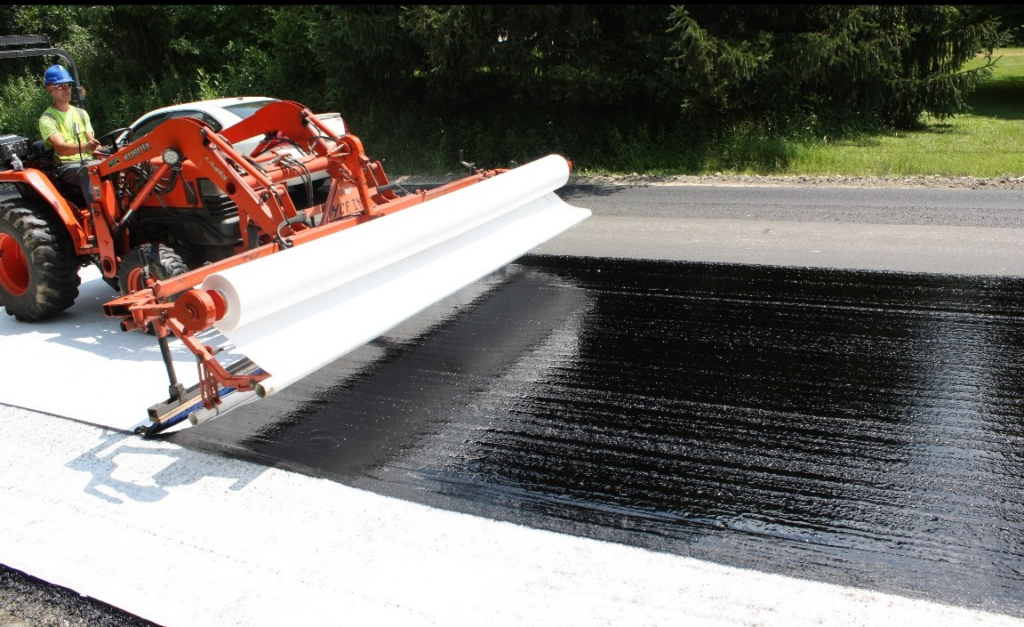
Geosynthetic interlayers are increasingly being utilized to extend the pavement lifespan and performance. Interlayers are placed between asphalt layers to provide reinforcement, stress relief and moisture protection.
There are three main mechanisms where geosynthetics can contribute to improving pavement performance. They are confinement/reinforcement, moisture control and stress relief.
- When the pavement is loaded vertically the load pushes the pavement laterally away from the load. Geogrids interlock with the aggregate particles restraining them from moving outward. This confinement makes the section more efficient in load distribution which spreads the load over a broader area significantly reducing pavement deformations and rutting.
- When a new asphalt overlay is placed over an old layer the cracks in the existing layer can quickly propagate through the new layer primarily due to pavement movement, temperature changes, and traffic loads. The geosynthetic placed in between the new and old pavements dissipates the stresses developed locally across the cracks which delays their propagation into the new pavement surface.
- As with all geotechnical and pavement applications, water is the leading cause for poor performance. Therefore, preventing water from penetrating into the pavement can improve the overall performance. Using a non-woven geotextile saturated with bitumen is a very effective barrier. Keeping surface water from seeping down into lower layers and moisture from rising via capillary action.
The inclusion of geosynthetics in pavement overlays address the three mechanisms for pavement distress which can result in increasing the time between maintenance intervals by delaying the initiation of rutting and reflective cracking. This in turn reduces the number of maintenance cycles which minimizes disruptions to roadway operations, congestion, and life cycle costs. In addition, the benefits also include reduced impact on the environment, improved rideability, safety and public satisfaction.
The demand on our roadways continues to increase with higher vehicle counts and increasing axel loads, both of which increase the damage to our roadways. The utilization of geosynthetics to help either increase the performance over a given service life or to manage the increased loading over the designed life is an important contribution of these products to the overall performance of the system.
Daniel E. Alzamora, P.E., is a contributing editor for Geosynthetics and has spent more than three decades in the geosynthetics industry in both the public and private sectors.
For additional information:
- U.S. Department of Transportation report to congress, “Comprehensive Truck Size and Weight Limits Study”, April 2016, https://highways.dot.gov/media/86081
- Mechanical response of flexible pavements enhanced with geogrid-reinforced asphalt overlays, https://sites.utexas.edu/zornberg/wp-content/uploads/sites/5286/2022/03/Correia_Zornberg_2016.pdf
- Geosynthetic Reinforcement in Asphalt Overlays for Increased Roadway Structural Capacity, https://rosap.ntl.bts.gov/view/dot/78817
- Installation of geosynthetic interlayers during overlay construction: Case study of Texas State Highway 21, https://www.sciencedirect.com/science/article/abs/pii/S2214391223002003