 TEXTILES.ORG




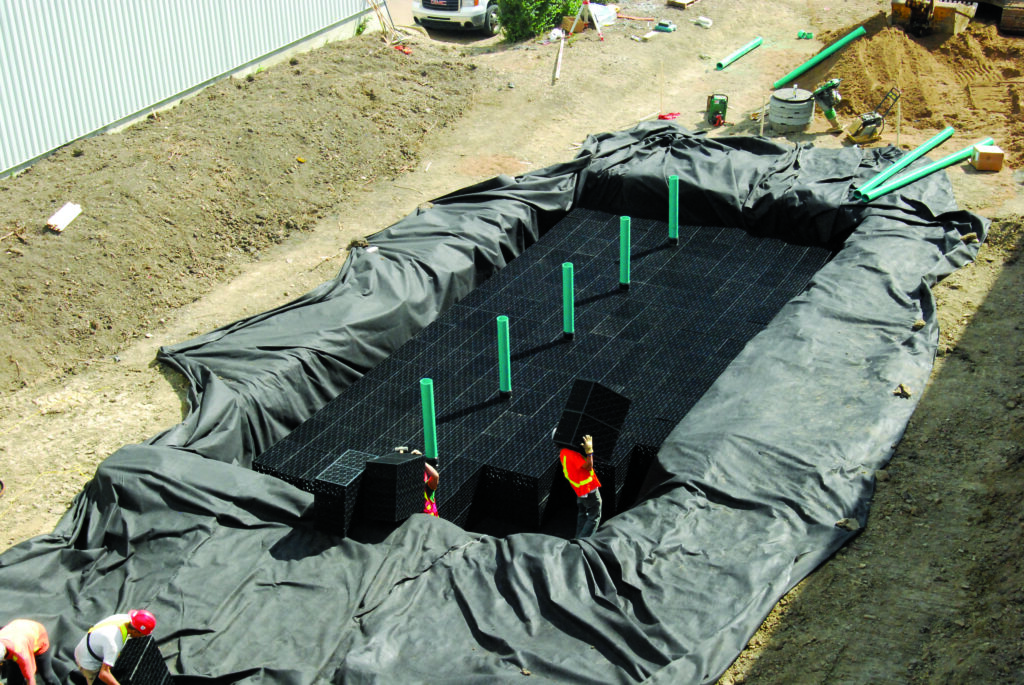
Transportation Department is shown. Layfield provided the modular underground stormwater tanks
and a nonwoven geotextile to prevent contaminants from polluting the surrounding environment. Photo courtesy of Layfield Geosynthetics.
Catastrophic hurricanes and raging windstorms. Epic floods and record-breaking droughts. Blazing heat waves and glacial cold snaps.
Extreme weather is becoming more the norm than the exception across the globe. As the impacts intensify, the need to minimize the destruction caused by such events is becoming acute. This is where geosynthetics can step in with solutions capable of safeguarding essential infrastructures and natural resources under severe conditions.
Daniel Selander, sales manager, Industry and Government Relations, for Willacoochee Industrial Fabrics Inc. (WINFAB®), Nashville, Ga., says there are multiple ways geosynthetics provide this support.
“In coastal and flood-prone regions especially, geosynthetics have been incorporated into designs to improve resilience against hurricanes, heavy rainfall and flooding, helping to protect both infrastructure and the surrounding environment,” Selander says.
“Living in the Southeast, I’ve seen firsthand how major storm events—going back to Hurricane Katrina—have reshaped design priorities,” he continues. “These high-profile disasters have brought more attention to erosion control and the role geosynthetics play in mitigating damage.”
Geosynthetics also help resolve “complex design challenges,” lowering the overall construction time and costs associated with such projects while making them more sustainable, Selander adds. This latter quality has become important since materials and building methods are increasingly scrutinized as to their life cycles and effects on the surrounding environment. (See Boyd Ramsey’s article on p. 18 for more on sustainability efforts in the geosynthetics industry.)
Brian Fraser, vice president of Layfield Geosynthetics , explains that part of how geosynthetics contribute to sustainability is by allowing civil and geotechnical engineers to build more durable, longer-lasting infrastructures better positioned to handle weather challenges.
However, although sustainability is of increased interest at the federal and state levels, it’s less of a concern for those designing or overseeing projects, usually not becoming a priority unless it lowers costs, Fraser adds. But because geosynthetics reduce the need for conventional materials such as rock, sand and aggregate, they’ve proven cost-effective options—qualities that help justify their use.
Manufacturers offer an array of geosynthetics solutions addressing the escalating threats caused by extreme weather, several of which are explored here.
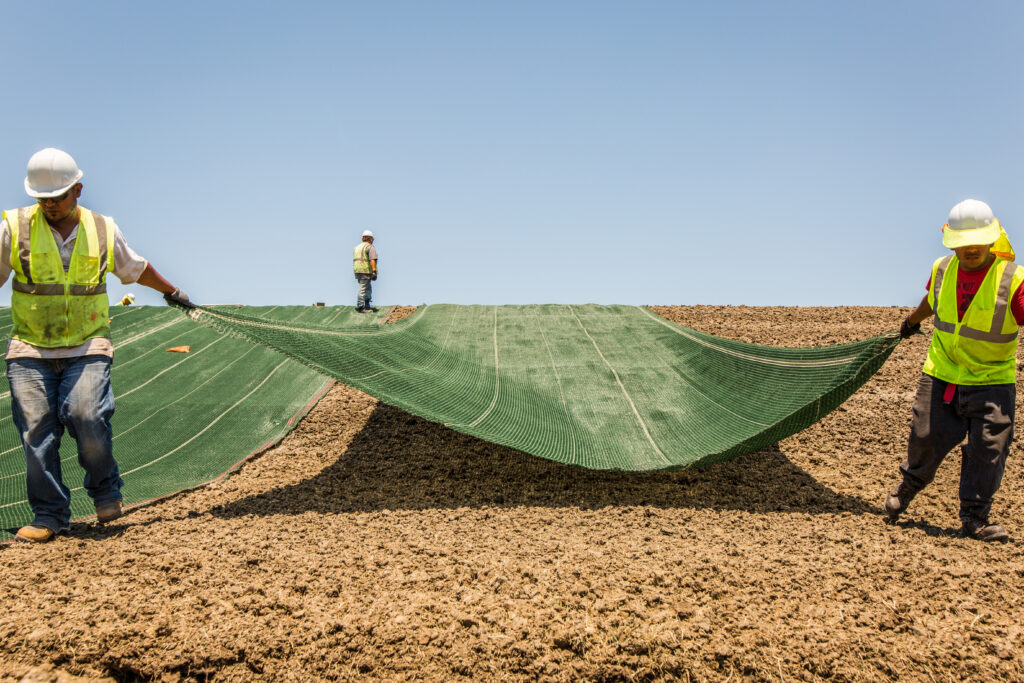
a High Performance Turf Reinforcement Mat with Engineered Earth Anchors™. The erosion control
system encourages the growth of vegetation, improving its performance by giving root systems
something stable to which they can attach. Photo courtesy of Solmax Americas.
Restoring and reconstructing
WINFAB specializes in domestically manufactured, high-performance geotextiles and industrial fabrics for civil and environmental construction, says Selander. Targeting the transportation, environmental and coastal markets, its products are used by public agencies, engineers and contractors.
Selander mentions a WINFAB project undertaken for the U.S. Army Corps of Engineers (USACE) as an example of how geosynthetics are being utilized. Beginning in March 2023 and dubbed the USACE Mid-Bay Phase 1 Ecosystem Restoration Project, it took place in Dorchester County, Md.
“The project aims to restore aquatic habitat, enhance biodiversity, improve navigational safety and support passive recreation,” he explains. “By reconstructing island and marsh systems, the effort strengthens long-term ecological resilience in an area that has experienced extensive habitat loss.”
WINFAB manufactured a high-performance, custom geotextile of woven polypropylene fabric with sewn seams. Approximately 175,000 square yards of this material were installed within the shoreline protection system. Serving as a soil stabilizer and filter, the geotextile provided a barrier between soil and armor stone, shielding the foundation from erosion and settlement while enhancing resilience against wave action.
There was plenty to contend with during installation, including unpredictable weather, tidal fluctuations, active-channel logistics and underwater installation requirements, says Selander, adding that the latter necessitated engineering a fabric designed to handle these placement conditions.
“A core component of this project was to use an American-made geotextile in alignment with federal Buy America provisions,” he says, referencing the Build America, Buy America Act (BABAA). “This requirement was integral not only to meeting specifications but to advancing broader national resiliency goals.
“The contractor executed the installation with exceptional precision, despite the challenging marine environment,” Selander continues. “The project fulfilled its design intent and established a solid foundation for subsequent restoration phases.”
He characterizes the outlook for geosynthetics as highly promising, especially as these materials consistently exhibit strong performance in practical applications. Even so, he adds, ongoing educational efforts within the engineering community would encourage wider adoption of these products.
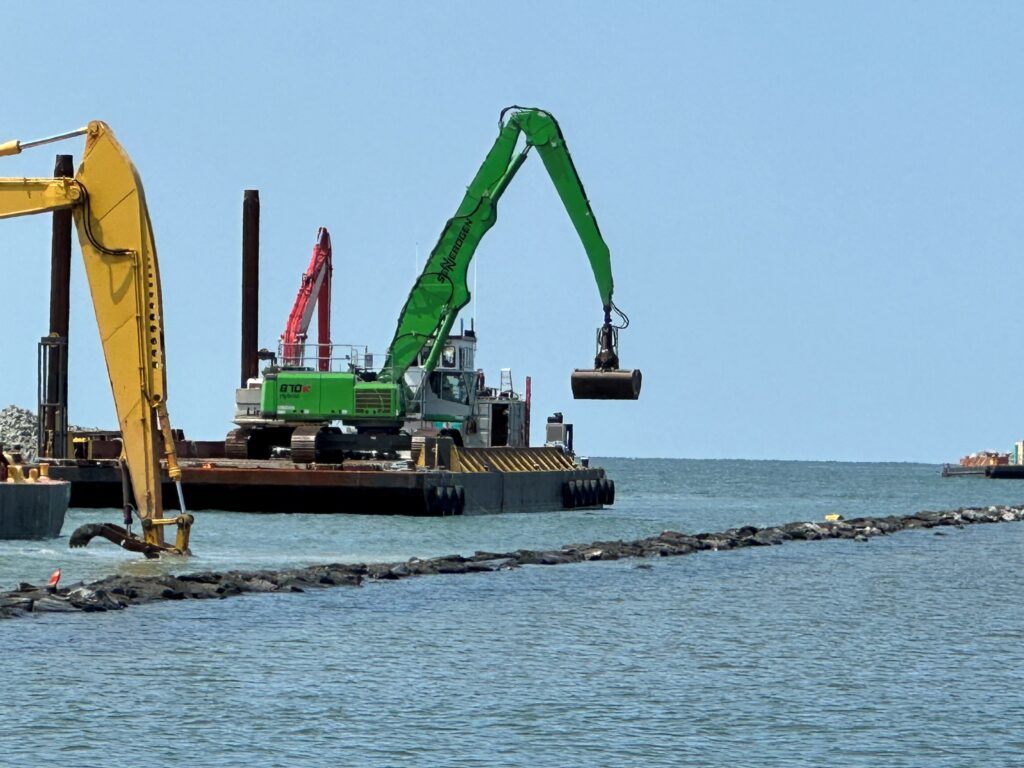
produced an engineered woven polypropylene fabric with sewn seams, designing this to withstand the
demanding underwater environment. Photo courtesy of WINFAB.
Reinforcing vegetation, mitigating erosion
With global headquarters in Montreal, Que., Solmax Americas provides sustainable construction solutions for civil and environmental infrastructure projects. The company has grown through various acquisitions, which at present include GSE Environmental, TenCate Geosynthetics and Propex, and has 21 manufacturing facilities worldwide.
Among Solmax’s offerings is a line of erosion-control systems engineered to address different types of erosion requirements. One is PROPEX® Armormax®, an earth-armoring system; another is PROPEX Pyramat® HPTRM (high-performance turf reinforcement mat). The former—which combines the Pyramat HPTRM with Engineered Earth Anchors™—has been deployed by the USACE to fortify levees against erosion and wave overtopping resulting from hurricanes, says Ben Campbell, PE CPESC, engineering business manager. But the system also is utilized for a broad array of applications where significant erosion challenges are present.
Pyramat HPTRM is designed for environments contending with direct sunlight exposure and limited vegetation. According to Brock Nesbit, AScT, engineering business manager, Western Canada, because of its high UV resistance and tensile strength, the mat provides up to 75 years of slope protection and erosion mitigation.
“This is also beneficial in arid and semi-arid environments, which are especially vulnerable to damage from flash floods due to the lack of vegetation,” Nesbit adds. “When it does rain, water isn’t absorbed quickly enough by the soil and vegetation and instead runs in any direction. Stabilizing channel slopes and mitigating erosion in these environments is essential.”
Both—specifically constructed to encourage vegetation growth, creating an effective defense against erosion—are comprised of extruded polypropylene combined with additives conferring increased longevity and performance in the field, says Campbell.
“These materials are then woven into a matrix that yields a pyramidal pattern,” Campbell explains. “Once installed in the ground, they’re intended to be semipermanent solutions. They’re not considered a temporary biodegradable solution, such as coconut or jute.
“Biodegradable solutions can be a good fit for certain erosion-prone scenarios,” he continues. “However, Armormax and Pyramat are best utilized in scenarios where conditions exceed the limits of biodegradable products.”
A project incorporating PROPEX Pyramat 75 HPTRM and Pyramat 25 (a turf reinforcement for mild to moderate slopes) was the Northwest Drainage Channel upgrade in Lloydminster, a Canadian city bordering Alberta and Saskatchewan, says Nesbit. Subjected to chronic flooding during major storms because of insufficient channel capacity and erosion, the decision was made to widen and reinforce the channel, providing long-term erosion protection in the process.
“This solution offered superior hydraulic resistance, promoted rapid vegetation growth and delivered significant environmental benefits compared to traditional hard armoring methods like riprap or articulating concrete blocks,” says Nesbit, adding that Pyramat’s “verified carbon footprint” is as much as 30 times lower than traditional alternatives, considerably reducing the project’s greenhouse gas emissions. Additionally, the vegetated system significantly improved water quality.
“The upgrade not only enhanced flood resilience but also provided aesthetic and ecological advantages, making it a sustainable choice for a community repeatedly impacted by flooding,” Nesbit says.
As for the near- and long-term demand for geosynthetics, Campbell says this will only increase, as more engineers dial into their “costs and schedule savings” compared to that of traditional materials. However, the challenge he sees is overcoming engineer hesitancy to try something different, describing them as somewhat “risk adverse.”
Storing, protecting water
Layfield’s portfolio includes multiple types of geosynthetics used by clients in the U.S., Canada and Australia for a diverse array of civil construction applications, says Fraser. Headquartered in Lakeside, Calif., the company serves waste management, natural resources (mining, oil, gas, alternative energy), agriculture, transportation, infrastructure and municipal water markets (one of the main markets for geomembrane floating covers, he says).
One project he mentions is the El Toro Water District R6 reservoir in Orange County, Calif., a 275-million-gallon reservoir providing 300,000 Orange County residents with drinking and emergency-supply water.
“[It’s] one of the world’s largest reservoirs using a geomembrane liner and floating cover system,” Fraser says. “Built in 1968 and expanded in 2000, the existing reinforced polypropylene cover showed signs of premature aging and stress resulting from UV exposure and chlorine chemical contact.”
The solution? A 45-mil CSPE (chlorosulfonated polyethylene) floating replacement cover and a 60-mil CSPE liner, both offering a 30-year weathering warranty and service life of at least that long. Installing the liner and floating cover took nine months, with the project completed in September 2023.
Geosynthetic floating covers are intended to protect water contained in large, above-ground reservoirs from contamination and eliminate evaporation loss, Fraser explains, adding these covers also are the most economical method for storing large amounts of drinking water.
Because of the reservoir’s irregular shape and massive size, the project posed some interesting challenges, including a nearly 24-acre surface that needed covering.
“[This] required the supply and installation of 2.4 million square feet of CSPE liner and floating cover,” he explains. “This required that approximately 400 custom-size factory-welded panels be produced and shipped from Layfield’s Lakeside operation to the project jobsite to be field-installed.”
According to Fraser, geomembrane liners and floating covers are seeing increased use around the globe as the planet warms and water becomes scarcer.
Another effort involved a dedicated stormwater management system for the Burien School District Transportation Department in Washington. This was deemed necessary to prevent pollutants (oil, fuel, petroleum-based fluids) leaked by vehicles in areas where they are regularly parked and maintained from contaminating the surrounding environment. Layfield constructed an infiltration system to address this issue.
The project required the installation of a modular, underground stormwater tank—Layfield provided these modules—and a nonwoven geotextile, NuBarrier™.
“[The infiltration system] was wrapped in the geotextile to deliver both filtration and hydrocarbon mitigation,” Fraser explains. “The use of an advanced nonwoven polypropylene geotextile engineered to retain oil and promote biofilm growth was an essential process that supported the natural breakdown of petroleum-based pollutants.”
Incorporating this sustainable nonwoven geotextile would also improve water quality and maintain “efficient filtration,” he adds. Additionally, combining the high-capacity modular stormwater tank with the geotextile provided an environmentally friendly solution tailored for areas where vehicle runoff containment is needed. The project was started and completed in May 2025. “By storing stormwater underground, these systems significantly reduce the footprint and space requirements for traditional above-ground stormwater ponds,” Fraser says, adding that their ability to “infiltrate large volumes of surface stormwater” also helps prevent flooding.