 TEXTILES.ORG




The use of geosynthetics for rail infrastructure continues to grow not only in the United States but also worldwide.
As with other applications like roads, waste management, mining and erosion, the use of geosynthetics is recognized as capable of delivering durable, sustainable and cost-effective solutions for rail infrastructure projects.
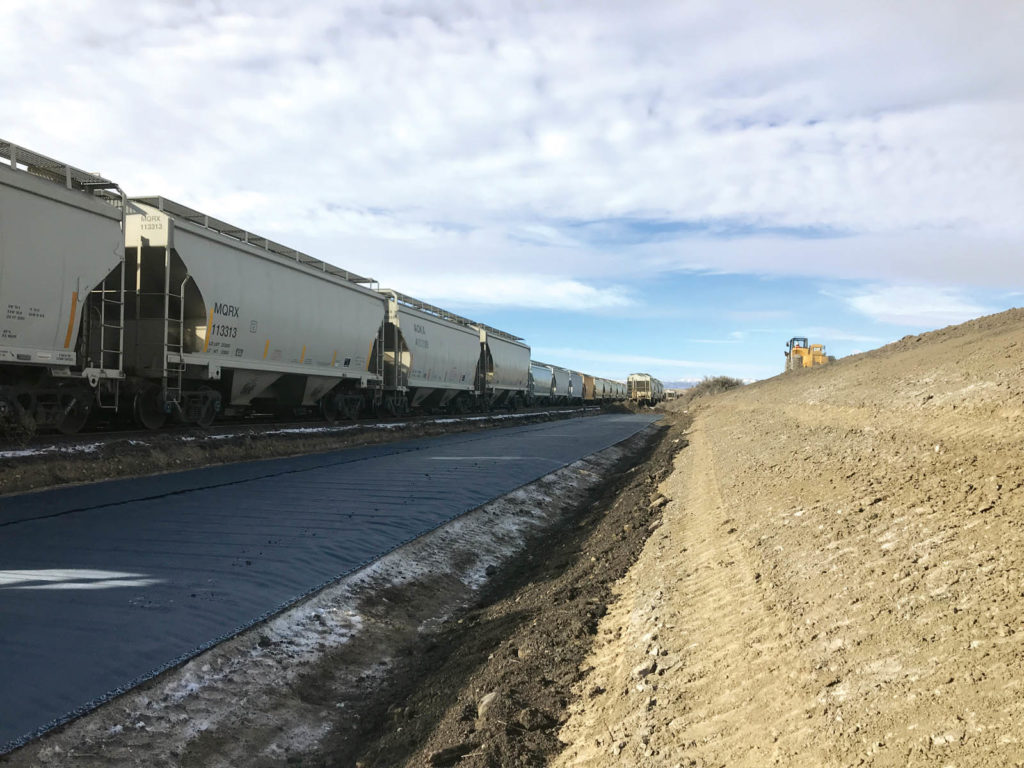
In many cases the use of geosynthetics is necessary to make projects constructable and economically feasible, particularly when constructing over soft saturated soils. Service downtime of rail lines has consequential impact in several important areas such as freight movement, the traveling public, and economy. Therefore, minimizing downtime of rail service is crucial in the design and construction of long-lasting and resilient transport corridors.
Geosynthetics for rail applications are used within the ballast or above the subgrade to enhance drainage, separation, stabilization and reinforcement of the rails support or foundation. Geotextiles can be used to manage moisture allowing flow of water while preventing migration of fine soil particles. Water can flow vertically up or down from rain, changes in elevation of groundwater, or from the buildup of pore pressure. Managing water and potential internal erosion of the system is important to maintain the stability of the rails. Geotextiles can also be used to separate significant gradation differences within the materials used to construct the embankment.
Ballast is exposed to heavy cyclic loads from trains causing rapid degradation of the ballast, consequently increasing loads felt by the subgrade. This can lead to lateral spreading and increased differential settlement. These issues can cause uneven track alignment vertically as well as laterally, which consequently cause track delays due to more frequent maintenance and repairs. In some cases, this causes the need to reconstruct the rail foundation system.
Geotextiles, geogrids and geocells are used for stabilization of the subgrade and/or reinforcement of the ballast by confining the aggregate. These materials have the effect of increasing the strength and stiffness response of the entire system minimizing differential settlement, lateral spreading and improving overall performance.
Increasing the time and extent of maintenance cycles resulting in reduced track downtime. These systems when considered during initial design can also be used to optimize between the thickness needed for the structural section and service life, allowing more flexibility to accommodate other competing design requirements.
In site conditions where tracks cross deep soft deposits along the alignment it is sometimes necessary to include deep foundation elements to support the embankment. In these cases, geosynthetics can be used to optimize the deep foundation element spacing by utilizing a geosynthetic reinforced load transfer platform to aid in the more uniform load transfer from the embankment to the foundation elements. This solution also has the effect of reducing lateral spreading and improving global stability.
Geosynthetics continues to be an important tool in the design of railway infrastructure around the world. This is due to their proven ability to contribute to the efficient and resilient design and construction of railway and other infrastructure.
Daniel E. Alzamora, P.E., is a contributing editor for Geosynthetics and has spent more than three decades in the geosynthetics industry in both the public and private sectors.