 TEXTILES.ORG




Soft or compressible subgrade is one of the most common — and most expensive — problems in embankment construction, whether the embankment carries a rail line, a roadway or a levee. The traditional toolbox is well known: surcharge preloading with wick drains, deep soil mixing, stone columns or pile-supported embankments. Each works, and each comes with a schedule and cost penalty that owners are increasingly unwilling to accept on projects with compressed timelines. Three-dimensional cellular confinement systems — geocells — offer a lower-cost, faster-to-install alternative for a meaningful subset of these projects, and the mechanism behind their performance is now well enough understood that they deserve a standing place in the ground-improvement toolbox rather than a case-by-case pitch.
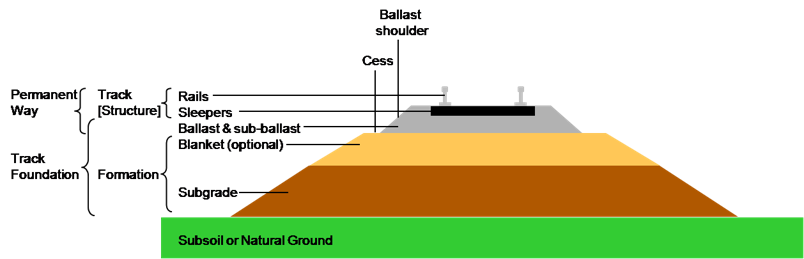
I studied this mechanism directly in a ground-improvement investigation of a geocell-reinforced granular layer at the base of a railway embankment, presented at a national conference on recent advances in civil engineering for global sustainability. The study combined field measurement with an engineering evaluation of the confined layer’s response under embankment loading. What follows is a practitioner-facing summary of what that mechanism means and how it translates into specification decisions.

How confinement actually works
A geocell is a honeycomb-like array of interconnected cells, typically expanded or welded from high-density polyethylene (HDPE) or a novel polymeric alloy (NPA), filled with granular soil or aggregate and placed as a mattress layer at the base of an embankment or beneath a pavement section. The performance improvement it delivers comes from three coupled mechanisms rather than one: lateral confinement of the infill material, which suppresses the lateral spreading that would otherwise occur under vertical load; a beam or membrane effect, in which the confined layer redistributes concentrated wheel or embankment loads over a wider area of the underlying soft subgrade; and an apparent cohesion effect, in which the confined granular fill behaves, in aggregate, as a stiffer and stronger material than the same soil would unconfined — effectively raising the composite layer’s bearing capacity without changing the soil itself.
In the railway embankment case, incorporating a geocell-confined granular layer at the embankment base measurably reduced vertical settlement and increased the bearing capacity of the section relative to an unreinforced control, consistent with this confinement mechanism, and did so using a bulk aggregate infill sourced locally rather than a specialty imported material — a meaningful cost consideration for rail and highway agencies working with constrained ground-improvement budgets.
Design considerations that drive performance
- Cell height and pocket size. Taller cells and smaller pocket diameters generally increase confinement stiffness but raise material cost and can complicate compaction of the infill in each pocket; the selection should be tied to the design traffic or embankment load and the subgrade’s undrained shear strength, not treated as a single default geometry across projects.
- Infill material selection. Well-graded angular aggregate mobilizes interlock and confinement more effectively than rounded, poorly graded fill. Where locally available material is marginal, a thin geotextile separator beneath the geocell layer protects against subgrade intrusion and preserves the confined layer’s designed stiffness over the service life of the embankment.
- Layer placement and number of lifts. A single well-compacted geocell mattress at the embankment base is often sufficient for moderate subgrade conditions; very soft subgrade (undrained shear strength below roughly 15-20 kPa) may warrant a multi-lift system or a combination with a basal geotextile or geogrid for tensile reinforcement in addition to the geocell’s confinement function.
- Seam and panel connection quality. Field performance is only as good as the panel-to-panel connection detailing; ultrasonically welded seams have shown more consistent field performance than mechanically fastened seams under repeated traffic or embankment settlement loading.
Where the cost and schedule case is strongest
Geocell confinement is not a universal substitute for deep ground improvement. On very soft or very deep compressible deposits, pile support or deep mixing remains the more defensible solution. Its strongest case is the mid-range problem: subgrade too weak for an unreinforced granular section but not so weak or deep that ground improvement to depth is unavoidable. In that range, a geocell mattress can be installed with conventional earthmoving equipment in days rather than the weeks required for surcharge-and-wait preloading schedules, with no curing time and no specialty drilling or mixing equipment mobilization. That combination of installation speed and reduced equipment mobilization is what has driven adoption on rail subgrade remediation, low-volume road embankments, and staged levee raises, and it is the argument that resonates most with owners evaluating ground-improvement alternatives on a schedule-constrained project.
Applications beyond the embankment
The same confinement mechanism extends the technology’s relevance well beyond railway and highway embankments: geocell mattresses are increasingly specified beneath mechanically stabilized earth (MSE) wall foundations to improve bearing on marginal fill, as channel and slope protection layers filled with vegetated topsoil or riprap in erosion-control applications, and as a load-support layer beneath unpaved access roads and construction platforms on soft ground where a temporary but trafficable surface is needed quickly.
Conclusion
The engineering community’s understanding of geocell confinement has moved from largely empirical to mechanistically grounded over the past two decades, and the ground-improvement industry should treat it accordingly — as a designed system with defined cell geometry, infill and layer-configuration variables, not a generic proprietary product to be specified by brand name alone. For subgrade conditions in the moderate range of weakness, geocell confinement deserves a seat at the table alongside preloading, stone columns, and deep mixing during the ground-improvement alternatives analysis, particularly where schedule and equipment mobilization costs weigh heavily in the owner’s decision.
About the author: Chirag Dhameliya, P.E., PMP, is a structural project manager at Vatani Engineering Consultants in Houston, Texas. He holds an M.S. in Civil Engineering from Texas A&M University-Kingsville and presented “Ground Improvement Technique in Railway Embankment by Geocell” at a national conference on recent advances in civil engineering for global sustainability.